Rauschenberg & Chamberlain
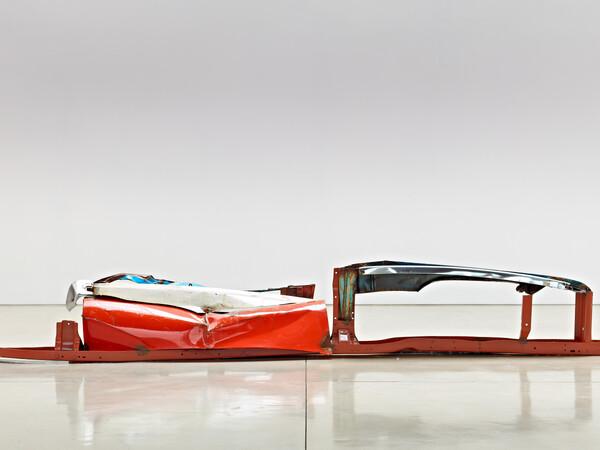
© 2026 Fairweather & Fairweather LTD/Artists Rights Society (ARS), New York | John Chamberlain, Gondola Walt Whitman, 1981–82. Painted and chrome-plated steel, 61x411.5x50.8 cm. Courtesy Gagosian I Ph. Douglas M. Parker Studio
Dal 5 Novembre 2026 al 1 Dicembre 2026
Luogo: Gagosian
Indirizzo: Via Francesco Crispi 16
Orari: Tuesday–Saturday 10–6:30
Telefono per informazioni: +39 06 4208 6498
E-Mail info: rome@gagosian.com
Sito ufficiale: http://gagosian.com
Among the most influential figures in postwar American art, Robert Rauschenberg (1925–2008) and John Chamberlain (1927–2011) redefined the boundaries between painting and sculpture through innovative approaches to materials. The artists attended the experimental Black Mountain College in North Carolina, albeit at different times, and emerged from the vibrant artistic milieu of New York in the 1950s. While Rauschenberg became renowned for his Combines, which incorporated everyday objects into compositions that blurred distinctions between artistic mediums, Chamberlain developed a distinctive sculptural language using salvaged automobile parts, transforming crushed and twisted metal into dynamic arrangements of color and form. Both artists found expressive possibilities in the discarded remnants of modern consumer society.
The bodies of work presented here both emerged following the artists’ respective relocations from New York to Florida, roughly a decade apart. In the fall of 1970, Rauschenberg settled on the island of Captiva off the Gulf Coast of Florida, sparking a shift in his artistic practice and a new body of work known as the Cardboards (1971–72). Made entirely from salvaged cardboard boxes—at first using ones that he had accumulated in his studio from his recent move—these wall reliefs retain all their original tears and dents, labels and stains, revealing the traces of their history.
The Cardboards, of which three quintessential examples are presented here, marked a continuation of Rauschenberg’s work with discarded materials. However, instead of the detritus of New York City’s urban streets, he now embraced ubiquitous cardboard as his primary material. In his innovative handling of cardboard boxes—flattening, bending, cutting, and stapling them—Rauschenberg was eager to harness the material’s innate expressive qualities.
In 1980, Chamberlain moved from New York to Sarasota, Florida, where he transformed a cavernous former lumber warehouse into an expansive new studio with twenty-two-foot-high ceilings. For the first time, he had ample room to work on a monumental scale, opening new possibilities for the size and complexity of his works. The following summer, while working on a massive public sculpture, Chamberlain was struck by an idea. Noticing the lengths of discarded channel steel left over from the sculpture and piled around his studio, he began to envision a series of horizontal floor sculptures. This idea gave rise to Chamberlain’s Gondola series (1981–82).
With their low, elongated forms stretching across the floor, the Gondolas marked a significant departure from the more compact, vertically oriented compositions that had previously characterized Chamberlain’s sculptural practice. As exemplified by Gondola Walt Whitman (1981–82), these works’ format and sweeping contours evoke the forms of Venetian boats, an association perhaps inspired by Chamberlain’s proximity to the waterways and marinas of Sarasota. Each of the Gondolas takes its name from a poet or writer Chamberlain admired, such as Whitman, reflecting his deep engagement with literature fostered during his studies at Black Mountain College.
This presentation coincides with Fireworks: Ileana Sonnabend and the Contemporary Art Boom, an exhibition curated by Mario Codognato at Palazzo Esposizioni Roma, which includes works by Rauschenberg—including an example from his Cardboard series—and is on view through April 4, 2027.
SCARICA IL COMUNICATO IN PDF
 MOSTRE A ROMA
-
 Dal 13 Aprile 2022 al 30 Aprile 2032
Musei Capitolini
I Colori dell’Antico. Marmi Santarelli ai Musei Capitolini
-
 Dal 6 Aprile 2023 al 31 Dicembre 2030
Casa di Giacomo Balla
Casa Balla
Visualizza tutte le mostre a Roma
MOSTRE IN PRIMO PIANO
-
 Dal 11 Novembre 2026 al 2 Maggio 2027
Asti | Palazzo Mazzetti
Alphonse Mucha
-
 Dal 10 Novembre 2026 al 23 Gennaio 2027
Milano | Tornabuoni Arte Milano
Lucio Fontana. Che splendida giornata…
-
 Dal 6 Novembre 2026 al 7 Marzo 2027
Napoli | Gallerie d’Italia Napoli
Angelica e Élisabeth. L’età delle donne pittrici
-
 Dal 10 Novembre 2026 al 24 Gennaio 2027
Firenze | Palazzo Strozzi
Joanna Piotrowska. Burrowed
-
 Dal 4 Novembre 2026 al 22 Agosto 2027
Brescia | Museo di Santa Giulia
TESORI. Il grande romanzo dei Musei bresciani. 1826 | 2026
-
 Dal 5 Novembre 2026 al 1 Marzo 2027
Milano | Fondazione Prada
Global Antiquity


